aurora · Aug 27, 2026
Reading an Aurora Forecast, Honestly
Numbers help you decide where to stand, not whether the sky will perform. A traveller's plain guide to the Kp scale, the cloud map, and the patience in between.
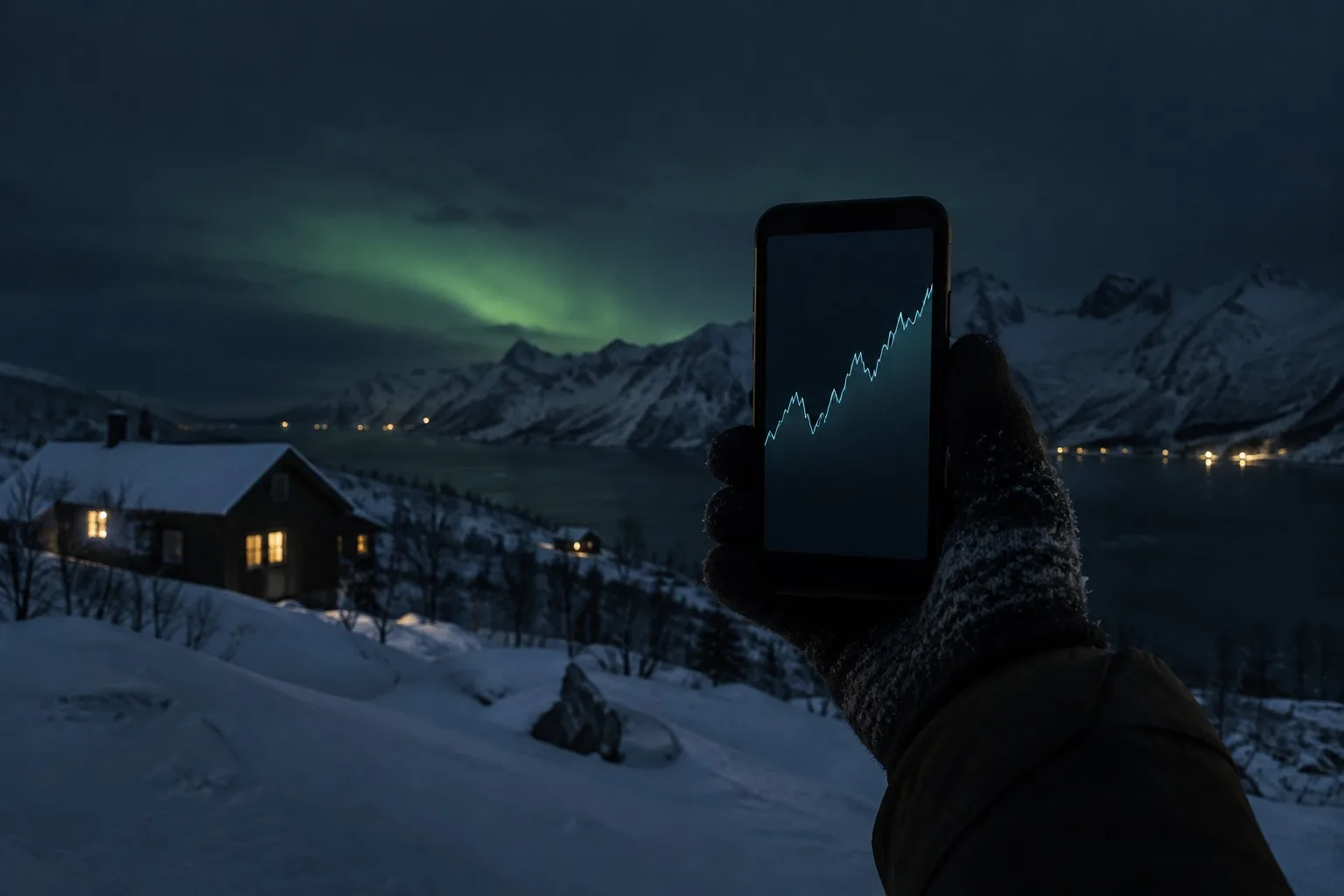
Let me say the unpopular thing first. Nobody can promise you the aurora. Not me, not your guide, not the app with the glowing green map. Anyone who does is selling you a ticket.
What a forecast can do is narrow the odds and tell you where to stand. That's worth having. It just isn't a guarantee.
What the number means
You'll see a figure called Kp everywhere. It's a measure of how disturbed the magnetic field around the planet is, on a scale from zero to nine. A higher number generally means the lights can reach further from the poles and may get brighter.
That's all I'll claim about it. When I first started reading forecasts I treated Kp like a score: a three was a bad night, a six was a good one. That's too neat. I've stood under a faint, weedy arc on a high number and watched the sky go wild on a low one. If you're already far north, you don't need a big number. If you're further south, you need a lot of luck as well.
Cloud matters more
Here's the thing the apps bury. The best aurora in the world is invisible behind a lid of cloud. I'd rather have a modest night with a clear sky than a spectacular one I can't see.
So I check three things, in this order:
The cloud forecast for my exact valley, not the region
The moon, because a bright one washes out the fainter displays
Only then, the activity number
If the first is bad, I stay in and drink tea. There's no shame in that.
Short range beats long range
I treat a forecast made a month ahead as hope rather than information. One made a day or two out is better. One made in the last half hour, with the sun's real-time wind readings behind it, is the closest thing to honest. I plan trips around long odds and decide each evening around short ones.
On our trip to Aurvik we spent four nights looking at a flat white sky. On the fifth, at ten past midnight, the cloud tore open like a curtain on a rail, and the lights came up green and low over the ridge. Our host knocked on the door before the app sent its alert. She'd simply looked out of the window.
How I actually plan
I book at least five nights. I choose somewhere dark, away from streetlights, with a window I can check at three in the morning. I build in slow days, so a missed night costs me a rest, not a ruined holiday.
And I keep a small rule: if I've seen nothing, I try not to measure the week against that. The sauna, the long walks, the strange blue noon were also the trip. The lights, if they come, are a gift on top.
Stay warm, check the cloud, and look out of the window now and then.
No comments yet
Comments are open. Have a thought or a question? Share it below.